98.0 kWh *Useable Battery
This electric vehicle is no longer for sale
A new model is available: Prices shown are recommended retail prices for the specified countries and practice not include whatever indirect incentives. Pricing for the UK includes the direct incentive of the "Plug-In Car Grant (PICG)". Pricing and included options tin differ by region and do not include any indirect incentives. Click on a land for more details.
Existent Range Estimation betwixt 400 - 780 km
| Metropolis - Common cold Weather condition * | 525 km |
| Highway - Cold Weather * | 400 km |
| Combined - Cold Weather * | 465 km |
| Urban center - Balmy Weather * | 780 km |
| Highway - Mild Weather * | 520 km |
| Combined - Mild Weather * | 635 km |
Indication of real-world range in several situations. Cold conditions: 'worst-case' based on -10°C and use of heating. Mild conditions: 'all-time-case' based on 23°C and no use of A/C. For 'Highway' figures a constant speed of 110 km/h is assumed. The bodily range will depend on speed, way of driving, weather and route weather.
Battery and Charging
| Battery Capacity * | 103.0 kWh |
| Battery Useable* | 98.0 kWh |
Europe
| Charge Port | Type ii |
| Port Location | Left Side - Rear |
| Charge Ability | 16.v kW AC |
| Accuse Time (0->550 km) | seven hours |
| Charge Speed | 79 km/h |
| Fastcharge Port | Supercharger |
| FC Port Location | Left Side - Rear |
| Fastcharge Ability (max) * | 250 kW DC |
| Fastcharge Fourth dimension (55->440 km) * | 35 min |
| Fastcharge Speed * | 660 km/h |
Energy Consumption
EVDB Real Range
| Range * | 550 km |
| Vehicle Consumption * | 178 Wh/km |
| CO2 Emissions | 0 chiliad/km |
| Vehicle Fuel Equivalent * | 2.0 l/100km |
WLTP Ratings
| Range | 652 km |
| Rated Consumption | No Information |
| Vehicle Consumption | 150 Wh/km |
| CO2 Emissions | 0 thou/km |
| Rated Fuel Equivalent | No Data |
| Vehicle Fuel Equivalent | 1.seven fifty/100km |
Rated = official figures as published by manufacturer. Rated consumption and fuel equivalency figures include charging losses.
Vehicle = calculated battery energy consumption used by the vehicle for propulsion and on-board systems.
Real Energy Consumption Estimation between 126 - 245 Wh/km
| City - Common cold Weather * | 187 Wh/km |
| Highway - Cold Weather * | 245 Wh/km |
| Combined - Cold Weather * | 211 Wh/km |
| Urban center - Mild Weather * | 126 Wh/km |
| Highway - Balmy Conditions * | 188 Wh/km |
| Combined - Mild Weather * | 154 Wh/km |
Indication of existent-globe energy use in several situations. Common cold atmospheric condition: 'worst-example' based on -10°C and employ of heating. Mild conditions: 'best-case' based on 23°C and no use of A/C. For 'Highway' figures a constant speed of 110 km/h is assumed. The energy use will depend on speed, style of driving, climate and route conditions.
Dimensions and Weight
| Length | 4970 mm |
| Width | 1964 mm |
| Width with mirrors | 2189 mm |
| Top | 1445 mm |
| Wheelbase | 2960 mm |
| Weight Unladen (EU) | 2290 kg |
| Gross Vehicle Weight (GVWR) | No Data |
| Max. Payload | No Data |
| Cargo Volume | 894 L |
| Cargo Volume Max | 1645 L |
| Cargo Volume Frunk | No Data |
| Roof Load | 75 kg |
| Tow Hitch Possible | No Data |
| Towing Weight Unbraked | 0 kg |
| Towing Weight Braked | 0 kg |
| Vertical Load Max | No Data |
Miscellaneous
| Seats | 5 people |
| Isofix | Yes, 2 seats |
| Turning Circumvolve | 11.eight m |
| Platform | TESLA Southward/X |
| Machine Body | Liftback Sedan |
| Segment | F - Luxury |
| Roof Rails | No |
| EV Dedicated Platform | Yes |
* = estimated value. Average energy consumption and range based on moderate drive style and climate. Real-life values may differ significantly. Pricing information might not be actual for some regions. No rights tin exist derived from the information on this site.
Home and Destination Charging (0 -> 100%)
Charging is possible by using a regular wall plug or a charging station. Public charging is always done through a charging station. How fast the EV can charge depends on the charging station (EVSE) used and the maximum charging capacity of the EV. The tabular array below shows all possible options for charging the Tesla Model S Long Range Plus. Each option shows how fast the battery tin can be charged from empty to full.
Europe
Charging an EV in Europe differs by country. Some European countries primarily use one-phase connections to the grid, while other countries are near exclusively using a 3-stage connexion. The table below shows all possible means the Tesla Model Due south Long Range Plus tin be charged, but some modes of charging might not exist widely bachelor in certain countries.
| Blazon two (Mennekes - IEC 62196) |
 |
| Charging Betoken | Max. Power | Ability | Time | Rate |
| Wall Plug (2.three kW) | 230V / 1x10A | two.3 kW | 50h15m | xi km/h |
| i-phase 16A (3.7 kW) | 230V / 1x16A | 3.7 kW | 31h15m | 18 km/h |
| 1-stage 32A (7.iv kW) | 230V / 1x32A | 7.4 kW | 15h45m | 35 km/h |
| 3-phase 16A (11 kW) | 400V / 3x16A | 11 kW | 10h30m | 52 km/h |
| 3-phase 32A (22 kW) | 400V / 3x24A | 17 kW † | 7 hours | 79 km/h |
† = Limited by on-lath charger, vehicle cannot charge faster.
Fast Charging (10 -> fourscore%)
Rapid charging enables longer journeys past adding as much range as possible in the shortest amount of time. Charging ability will decrease significantly afterwards fourscore% state-of-charge has been reached. A typical rapid charge therefore rarely exceeds 80% SoC. The rapid charge rate of an EV depends on the charger used and the maximum charging power the EV tin handle. The table below shows all details for rapid charging the Tesla Model S Long Range Plus.
Tesla has not released details about rapid charging the Model Southward. The information below is based on estimated values of the most likely rapid charging capabilities.
- Max. Power: maximum power provided by charge signal
- Avg. Power: average power provided by charge point over a session from 10% to 80%
- Time: time needed to charge from 10% to 80%
- Rate: boilerplate charging speed over a session from 10% to 80%
Europe
| Type 2 (Mennekes - IEC 62196) |
 |
| Charging Point | Max. Power | Avg. Power | Time | Rate |
| Supercharger v2 Shared (75 kW DC) | 75 kW | 65 kW † | 67 min | 340 km/h |
| Supercharger v2 (150 kW DC) | 150 kW | 105 kW † | 41 min | 560 km/h |
| Supercharger v3 (250 kW DC) | 250 kW | 125 kW † | 35 min | 660 km/h |
| This vehicle does not support Autocharge |
† = Limited by charging capabilities of vehicle
Autocharge: allows for a vehicle to initiate charging automatically on supported CCS accuse points.
Actual charging rates may differ from data shown due to factors like outside temperature, state of the battery and driving style.
Preceding model
The model shown on this page is the successor of the Tesla Model S Long Range, which was available from Apr 2019 until October 2020. The previous model had 25 km less range, same acceleration and was similar in energy consumption.
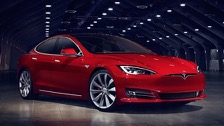 Preceding model Tesla Model S Long Range



0 Response to "Tesla Model S Long Range Plus"
Post a Comment